

Celebrating Music, Culture & Family Through Fashion: Breaking Down Bad Bunny’s Iconic Super Bowl LX Look

On February 8th, 2026 Puerto Rican singer Benito Antonio Martínez Ocasio, most commonly known as Bad Bunny, took the stage for the Apple Music Halftime Show at Super Bowl LX in Santa Clara, California. Being a frequent and longtime listener of his, I very much looked forward to seeing what the performance would entail. I talked with friends about our setlist predictions, guesses for who he’d bring out, and set design expectations. As a fashion lover, viewing Bad Bunny’s show through a stylistic lens intrigued me. I could go on for days about it, but here I’ll focus on a few key points.
Designed by Zara, Bad Bunny wore a cream ensemble with “Ocasio 64” on the back of his top, a tribute to his late uncle, Cutito. Capping off the outfit was a pair of his new signature shoe with Adidas, the “BadBo 1.0.” It was very fitting of Bad Bunny to wear an outfit honoring his family. His work is a reflection of his pride in who he is and where he comes from, which is fully encapsulated in his performance. He said himself (translated into English): “... and if I’m here today at Super Bowl LX, it’s because I never, never stopped believing in myself. You should also believe in yourself.”
The Halftime Show performance also included many musicians, actors, dancers, and other talent. An ensemble of dancers donned white cropped tanks, flowy tan skorts, along with a pair of black and white Adidas Sambas. Bad Bunny has been a collaborator of Adidas since 2021, releasing predominantly sneakers. It began with “The First Café” Forum Buckle Low. As mentioned earlier, he also debuted his latest model with the brand, wearing the Bad Bunny “BadBo 1.0” during Sunday’s show.

Since his 2025 “No Me Quiero Ir de Aquí” residency in San Juan, Puerto Rico, La Casita (transl. “little house”) has become a central focal point of Bad Bunny’s shows. With its light pink exterior and bright yellow trimmed roof, each show features an ensemble of different celebrities at the front. Some included at this year’s Super Bowl were Jessica Alba, Cardi B, and Pedro Pascal. La Casita was designed to be like the house featured in the short film for the album Debí Tirar Más Fotos. The aforementioned album and residency, in my eyes, have helped skyrocket Bad Bunny’s career. It has spread his messages of Puerto Rican issues, including colonialism and gentrification.
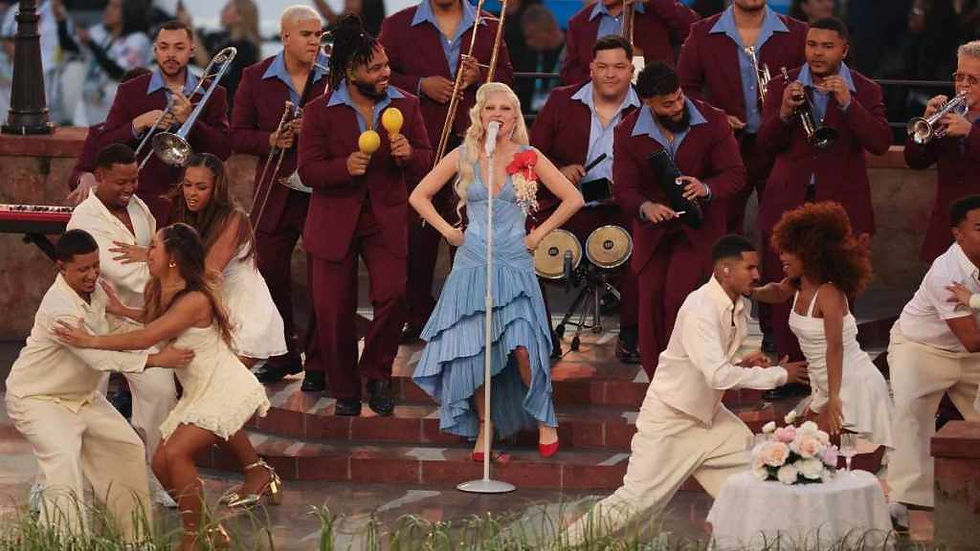
After the (real!) wedding that took place on the rooftop of La Casita, Lady Gaga was revealed and performed a salsa version of her hit song with Bruno Mars (not present), “Die With A Smile.” The singer wore a sky blue dress with ruching, a layered skirt, red heels, and a red flower boutonniere, accompanied by smaller, dangling white ones. Her supporting band donned burgundy suits and dress tops with a similar color to that of Gaga’s dress. Dancers surrounding them wore all-white looks. Each look referenced the colors of the Puerto Rican flag, which was a thoughtful touch.

Lady Gaga wasn’t the only musical guest at the Halftime Show. Musical legend, also from Bad Bunny’s homeland of Puerto Rico, was Ricky Martin, singing part of Bad Bunny’s song “Lo Que Le Pasó a Hawaii.” Martin sat in one of two white plastic chairs, on a set designed to replicate the album cover of “Debí Tirar Más Fotos.” Martin’s outfit, similar to that of the dancers, was mostly white with accessories including an earring and some bracelets. Martin’s presence was poignant for his own contributions in and out of music in Puerto Rico and worldwide, including the Ricky Martin Foundation, which educates and advocates against human trafficking.

Lastly, I can’t not mention the many performers dressed as sugarcane bushes throughout Bad Bunny’s performance. The bushes weren’t just there to represent scenery, but like much of the performance and Bad Bunny’s work, also a part of Puerto Rican history. Sugar was once a huge part of Puerto Rico’s economy, from producing 12.5 million tons of sugarcane in 1952 to less than 20,000 tons in 1998. Puerto Rico’s sugar plantations are a direct example of the harm colonialism has caused.
From the fashion to the stage design and the heartfelt tributes, every element of the show felt intentional. Bad Bunny’s Super Bowl LX Halftime show was more than a concert, it was a moment intended to celebrate music, culture, and family. I am very excited to see what Bad Bunny will do with his career and music in the future.
Written by Jenna Bodek
Edited by Graeme Duffey


Comments